
The Telescopic Cylinder is a direct engine
that is utilized for empowering straight development. Working either with the
assistance of fluid weight (hydraulic cylinder) or with the assistance of
compacted air (pneumatic cylinder), the primary preferred position of placing
these sorts of cylinders being used is that they are space advantageous.
Another significant element of the telescopic
cylinder is its straightforward structure which makes its support simple.
Contingent upon the number of poles in the telescopic plan, the telescopic
cylinder can be called as an n-arrange telescopic cylinder (where n is the
number of poles in the cylinder).
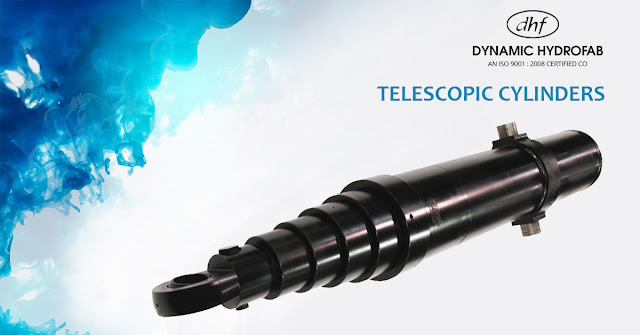
Telescopic cylinders or multi-organize cylinders are made out of various cylinders stacked on one another. Where the cylinder barrel likewise goes about as a cylinder pole. Cylinders can have two, three, four, five or even six phases. They are regularly utilized where the cylinder establishment length is not exactly the necessary stroke. Most telescopic cylinders are single-acting, yet there are likewise twofold acting telescopic cylinders accessible. These types of cylinders can easily be purchased by Telescopic Cylinder Manufacturers.
The straight engine
which works with the assistance of fluid working substance like oil is a
hydraulic cylinder. The structure of a hydraulic Telescopic cylinder
includes a base end and a pole end, the two of which are fixed to stay away
from the spillage of the working substance. The pole end has the arrangement of
associated empty bars which can be crumpled one into another like in a telescope.
The empty poles continuously get bigger in size as they move towards the base
end.
Telescopic cylinders or multi-organize cylinders are made out of various cylinders stacked on one another. Where the cylinder barrel likewise goes about as a cylinder pole. Cylinders can have two, three, four, five or even six phases. They are regularly utilized where the cylinder establishment length is not exactly the necessary stroke. Most telescopic cylinders are single-acting, yet there are likewise twofold acting telescopic cylinders accessible. These types of cylinders can easily be purchased by Telescopic Cylinder Manufacturers.
Telescopic hydraulic
cylinders, now and again called multi-organize cylinders, are a sort of direct
actuator consisting of a progression of rounded bars called sleeves. The
sleeves (generally four or five) successively decline in distance across and
are settled within one another.
When hydraulic weight
is acquainted with the cylinder, the biggest sleeve (called the principle or
barrel) is broadened first. When the barrel has arrived at its most extreme
stroke, the following sleeve, typically alluded to as a phase, broadens. This
procedure proceeds until the cylinder arrives at its last stage, called the
unclogger.
There are
two unique kinds of telescopic hydraulic cylinders
single-acting
cylinders and twofold acting cylinders. Single acting, by a wide margin the
most well-known, work by utilizing gravity or some other outer power to
withdraw the phases of the cylinder. When weight is discharged from the
cylinder, the power of the heap pushes oil out of the framework and the
cylinder withdraws.
While pneumatic
telescopic cylinders exist, hydraulic force is substantially more typical,
particularly when overwhelming burdens are being moved. With a crumbled length
ordinarily between 20-40% of the completely broadened length, telescopic
hydraulic cylinders are utilized when expansion should be started from a tight
space. This augmentation ability makes a more drawn out working stroke than would
be conceivable with a solitary stage bar-style actuator. These abilities,
alongside the ability to deal with extremely overwhelming burdens, make dump
trucks, lifts and waste vehicles the absolute most basic applications for
telescopic cylinders. One can easily purchase these cylinders from Telescopic Cylinders Suppliers.


.jpg "Top 5 Hydraulic Cylinder Manufacturers for Industrial Applications")

.jpg "Why You Should Use Hydraulic Cylinders in Your Industry?")
